
In 2023, Toulu Akerele, the global Data Protection Officer and Information Security Management System (ISMS) Manager at Paystack, started educating herself about AI governance amid the growing AI buzz following ChatGPT’s popularity. Her efforts initially didn’t gain much traction as Paystack was not actively building with AI at the time.
Over the past two years, however, she has taken on the role of AI governance, particularly as the use of AI tools has increased globally and team members have adopted them. The growth of Cursor, an AI coding assistant, reflects this wider shift. It reached a million daily users in March and generated $500 million in annual recurring revenue by June, driven largely by word-of-mouth growth.
At the core of Paystack’s preparations for company-wide AI adoption was education and training. Senior leadership, including the CTO Ezra Olubi and Akerele, led sessions on the safe use of generative AI at work, organized role-playing orientation sprints that allowed employees to explore the AI value chain through the lens of developers, deployers, and end-users, and shared newsletters on AI trends and regulations. CEO Shola Akinlade also championed an AI Awareness Month, where Stacks, as Paystack employees are called, get a meeting-free Friday to build with AI.
AI at work in Paystack
Like other engineering teams, Paystack uses Cursor, but only after a pilot program involving about five people, which was reviewed by the CTO and members of an AI development working group the company had established. Cursor has delivered some impressive dividends for team members, Akerele told me.
An internal survey showed that 100% of users noticed significant time savings during coding tasks using Cursor, with one person saying they can now work twice as fast, while 83% said it helped them the most with writing new code. Paystack also uses GitHub Copilot, an AI-powered coding assistant, and has reaped enough benefits to continue usage.
Paystack has quickly developed a culture that encourages employees, in both technical and non-technical roles, to integrate AI in their workflow. Yanis Sid-Lakhdar, Paystack’s Revenue Operations and Strategy Officer, who is building a prototype go-to-market deal assistant that allows the sales team to cut review time and focus on selling, is most excited about AI’s ability to fast-track his learning, improve his productivity, and customize agents that can streamline his workflow. For Sid-Lakhdar, the most exciting moment with AI tools was when he realised he could code queries and build dashboards in Python, SQL, and Java without having to spend months learning the languages in-depth. “I already had some basics, but with AI I can now move 10x faster – building analyses and insights in hours that would’ve taken me days or weeks before,” Sid-Lakhdar said.
In his role, what excites him most is the ability to create customized AI agents that are deeply integrated into his workflow, since off-the-shelf tools rarely fit perfectly. “The fact that I can now design agents that automate tasks, connect directly with my tech stack, and deliver a high level of customization – all without needing a dedicated engineering team – is exceptional. It massively optimizes ROI and gives RevOps a whole new level of leverage,” he added.
When Lisa Toms needed technical support in the past, she had to book time with an engineer, often working around their limited availability. Now, as Paystack’s Data Analytics Principal, she says Cursor has transformed the speed and accessibility of her work. “I could ask questions, debate approaches, get guidance, and even build out proof-of-concept code — all instantly,” says Toms.
But using Cursor wasn’t so easy at the beginning. According to Toms, she spent three frustrating weeks trying to figure out how to work effectively with the tool while navigating bias, over-complication, and plenty of dead ends. “I realised I had to approach its outputs with an open but critical mind. Ultimately, I hold the context of what I want to achieve, and it’s my responsibility to validate whether Cursor’s guidance gets me there. Once I adapted my approach, it became an incredibly powerful partner,” she reflected.
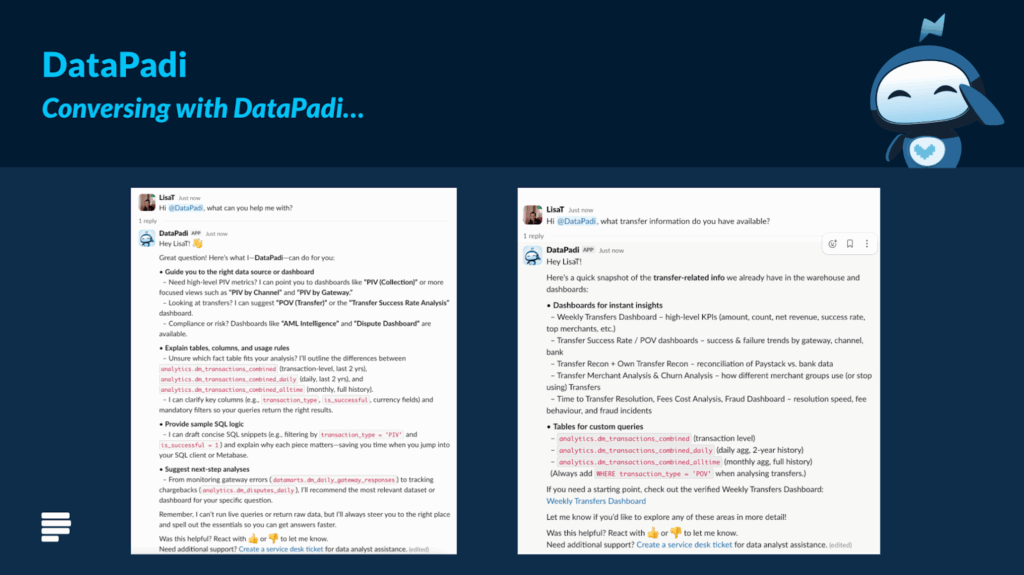
Paystack’s employee-built AI bot, DataPadi, helps teammates instantly source key data
Armed with this knowledge, during Paystack’s AI Awareness Month, Toms built DataPadi, a bot that allows team members to access and make sense of internal data without having to pull in human data analysts. “It was born from wanting to empower Stacks to engage directly with data and reduce dependency bottlenecks, while also ensuring the tool truly fits our specific needs,” Toms recalled.
Thanks to AI, Alexander Fasoro, Paystack’s Head of Frontend Engineering, has developed a process that reviews code more quickly. Fasoro, who also serves on the AI development working group, uses OpenAI’s coding agent, Codex, to automate the code review process, enabling engineers to get faster feedback on their work. By structuring a code review as a human reviewer would for each repository, the system has helped minimize errors and share valuable insights for improving code. Apart from current employees building AI tools, Paystack has also started considering requiring prospective employees to have a certain level of AI familiarity.
A McKinsey report revealed that software developers can complete coding tasks up to twice as fast with generative AI. The research showed that developers wrote new code in nearly half the time and optimized existing code, known as refactoring, in about two-thirds the time. McKinsey noted that with the right upskilling and enterprise support, these speed gains could translate into productivity improvements beyond past advances in engineering. While AI tools saved less time on more complex tasks, the survey found they did not sacrifice quality for speed when developers and tools collaborated effectively.

Managing the risks associated with AI usage
According to Akerele, employees are also encouraged to treat tools like Cursor as assistants rather than replacements, preventing overreliance that could weaken problem-solving skills.
Moreover, Akerele has established and maintained a set of guidelines for AI tool sourcing, usage, and monitoring. When team members want to work with new third-party AI tools, they must document the associated risks, the data collected, how it’s used, and the security measures in place. The goal isn’t to block innovation but to implement protective layers that safeguard team members, merchants, and their customers, Akerele said.
To mitigate some of the risks associated with integrating AI into the company’s workflow, Paystack operationalized some safety measures and guardrails. For instance, personal data is only shared with third-party AI tools if Paystack has an enterprise account where data is secured and not used for training other models. Data sharing also depends on a lawful basis under data protection laws.
“You can use AI so long as that third-party tool is not training on our data,” Akerele told me. “We collect and process a lot of sensitive data.”
Paystack maintains an AI tooling inventory with detailed documentation of all third-party and in-house AI tools, ensuring data protection and governance while offering a step-by-step guide for proposing new ones. Team members proposing new tools must conduct due diligence, exclude sensitive or copyrighted code from public repositories, and document the data the tool collects, along with its legal and privacy risks. Paystack also makes it a habit to activate AI features in tools already within its ecosystem, like Zoom or GitHub, where compliance and security have been vetted.
Conversely, some popular AI tools are deliberately avoided because they fail ethical requirements. “At Paystack, the principle is simple: innovation is at the forefront, but compliance and security are non-negotiable. We keep AI adoption practical, thoughtful, and locally relevant, always balancing efficiency, risk, and responsibility,” she added.
Paystack’s structured approach to AI governance reflects a broader shift among African tech companies like Darli AI and other sector innovators, who are beginning to define what responsible AI looks like in emerging markets. Beyond simply adopting global frameworks, these firms are translating principles of safety, transparency, and fairness into practices that fit local realities, from data protection to ethical deployment.